Qualcomm Technologies has announced the Snapdragon Reality Elite Platform at Augmented World Expo, bringing a new XR-focused solution designed for future virtual reality (VR), mixed reality (MR), and augmented reality (AR) devices. The new platform combines high-performance computing, on-device artificial intelligence, and improved power efficiency to support a wider range of immersive devices.
The Snapdragon Reality Elite Platform is aimed at both all-in-one video-see-through (VST) headsets and lightweight optical-see-through (OST) XR glasses. Qualcomm says the platform is designed to help manufacturers build devices with better visuals, faster responses, and longer usage times.
The XR industry continues to grow, with millions of devices already available in the market. Qualcomm believes the next generation of XR products will require more processing power and smarter AI features to deliver realistic environments and natural interactions.
Key features of Snapdragon Reality Elite include:
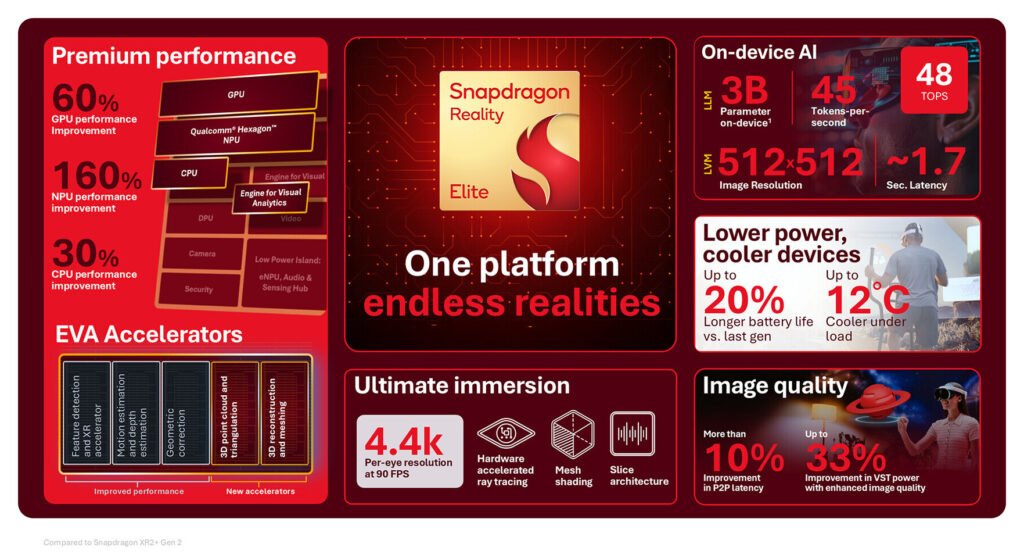
- Up to 48 TOPS of on-device AI performance for running advanced AI models directly on XR devices
- Support for large language models and vision models for smarter XR applications
- Up to 60% higher GPU performance compared to previous solutions
- Up to 30% CPU performance improvement for demanding workloads
- Up to 160% higher NPU performance for AI-based tasks
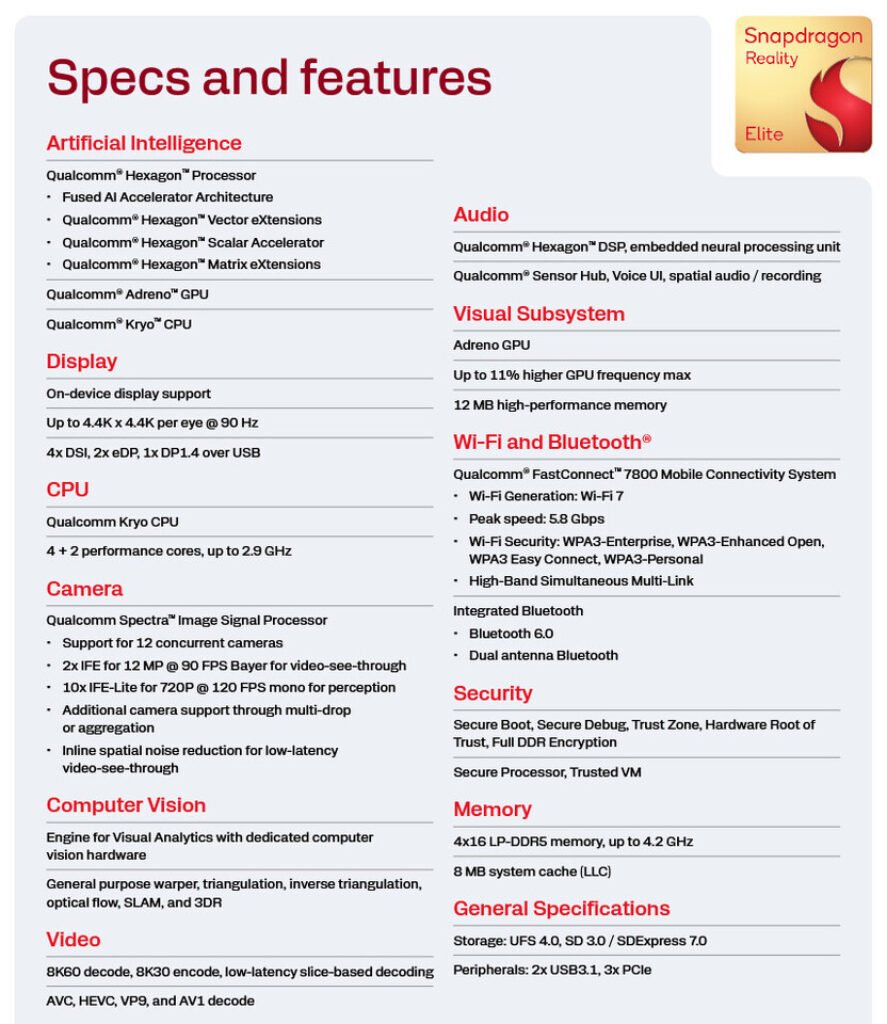
- Support for displays with up to 4.4K resolution per eye at 90Hz
- Improved video-see-through processing with reduced latency
- Up to 20% longer battery life under similar workloads
- Lower operating temperatures with up to 12 degrees Celsius cooler chipset performance
Qualcomm is focusing on generative AI for XR, enabling developers to build AI-powered experiences that can respond to users and their surroundings in real time. Snapdragon Reality Elite supports features such as more realistic digital avatars, AI-based assistants, and dynamic object creation through large vision models.
The platform also improves important XR functions such as hand tracking, head tracking, and environmental understanding. These upgrades can help digital content appear more naturally inside the user’s physical space, making mixed reality applications easier to use.
For developers, the increased performance gives more flexibility when creating XR experiences. Higher GPU and NPU capabilities allow applications to handle detailed environments, complex visual effects, and AI processing without relying heavily on cloud services.
Qualcomm has also focused on making XR hardware more comfortable. The company says Snapdragon Reality Elite improves efficiency by reducing power consumption and heat output. This could help device makers create lighter headsets and glasses that are easier to wear for longer periods.
The new platform will also play a role in upcoming XR products from Qualcomm’s partners. XREAL has confirmed that its Project Aura XR glasses will use Snapdragon Reality Elite, while Play For Dream plans to adopt the platform for its next-generation immersive devices.
With Snapdragon Reality Elite, Qualcomm is continuing to expand its presence in the XR market by providing manufacturers with a platform that combines AI processing, graphics improvements, and efficient performance for future spatial computing devices.