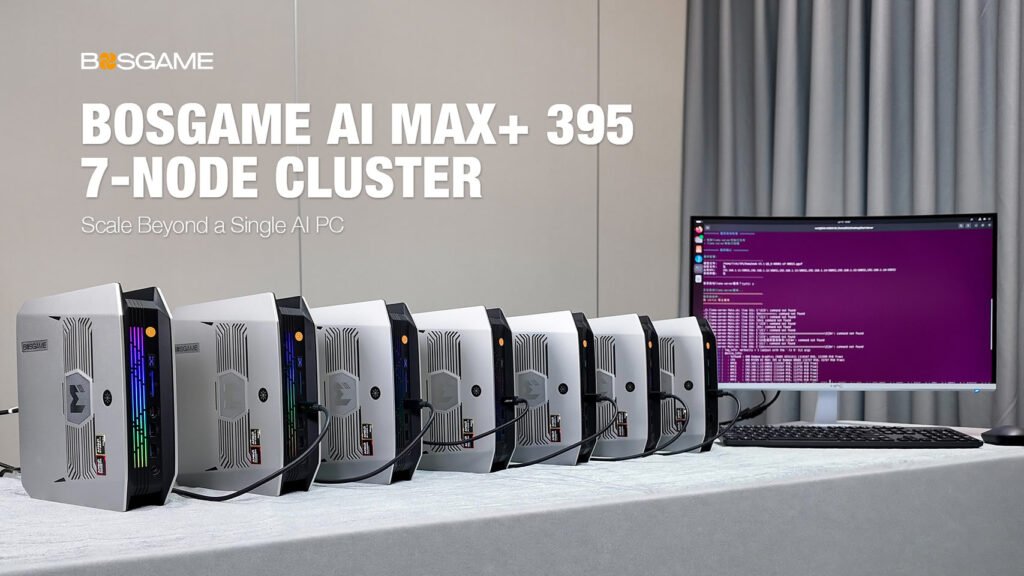
Bosgame has demonstrated a new AI computing setup based on its AI MAX+ 395 Cluster, featuring seven M5 AI Mini PCs working together to run the DeepSeek-V3.1 671B-parameter large language model. The company’s demonstration focuses on distributed AI inference, showing how multiple compact Mini PCs can be combined to handle workloads that may exceed the memory capacity of a single AI PC.
As AI models continue to increase in size, local AI deployment has become more demanding. Large language models require significant memory and processing resources, making them difficult to run on standard consumer hardware. Traditional AI servers can provide the required performance, but their high cost, power consumption, and complex installation requirements can limit access for smaller organizations, developers, and research teams.
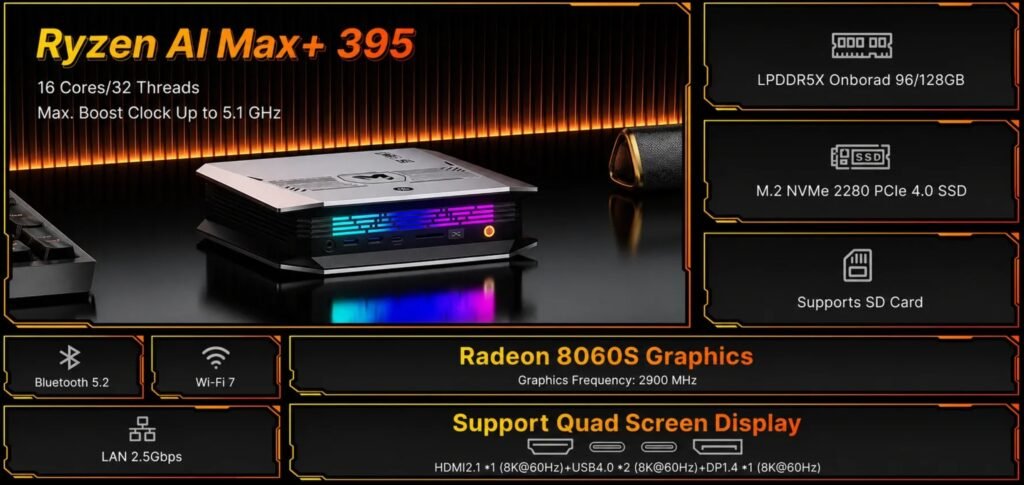
Bosgame’s AI MAX+ 395 Cluster uses a modular approach by connecting multiple M5 AI Mini PCs through USB4 Direct Connection. Instead of depending on one large server, the system distributes AI inference tasks across several nodes, allowing users to create a larger computing environment by combining multiple smaller devices.
Key details of the Bosgame AI MAX+ 395 Cluster include:
- Seven Bosgame M5 AI Mini PCs connected as a unified AI computing system.
- Support for distributed inference of the DeepSeek-V3.1 671B-parameter model.
- A combined memory capacity of 896GB Unified Memory across all nodes.
- Up to 672GB of Unified VRAM available for AI workloads.
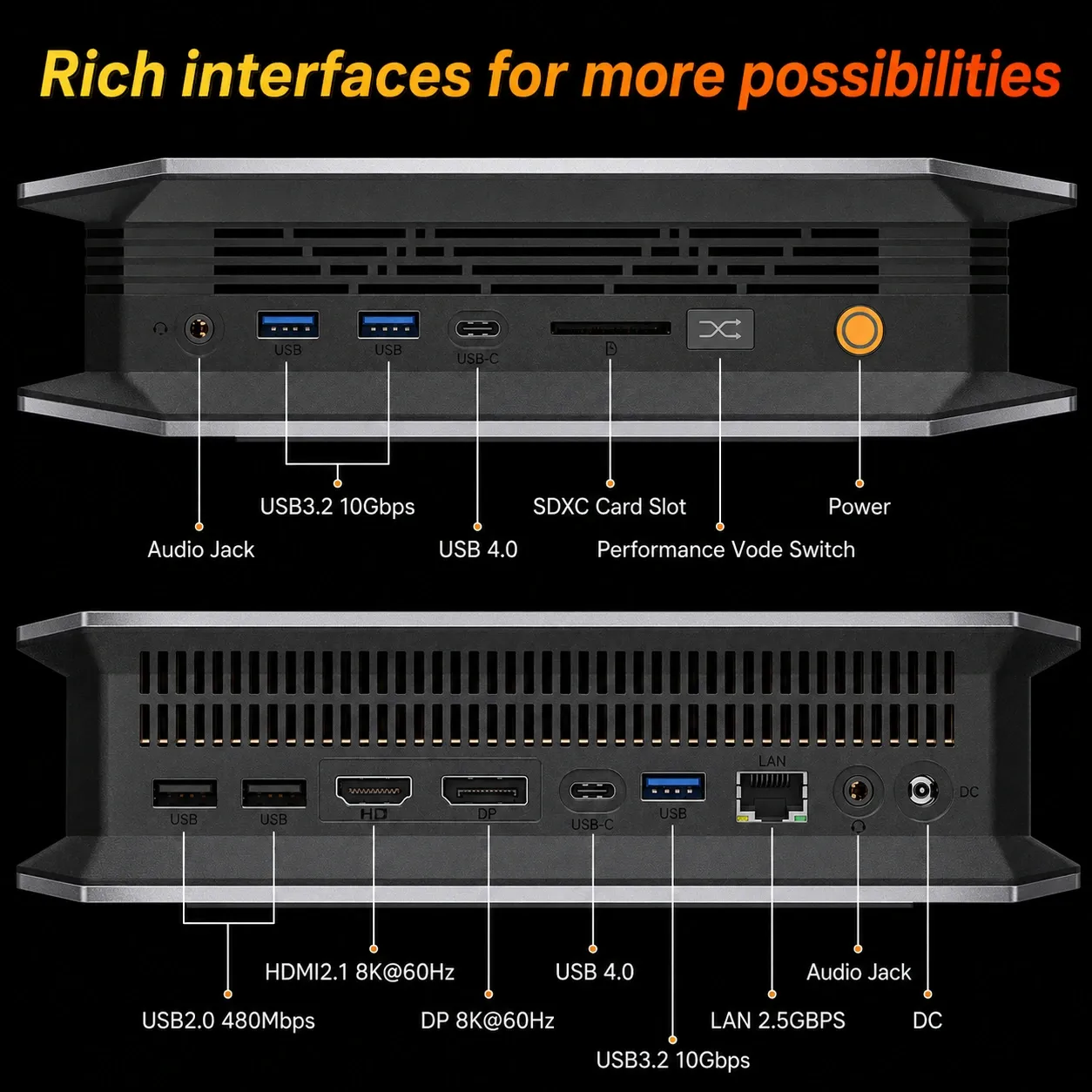
- USB4 Direct Connection for communication between cluster nodes.
- Support for local AI development through Llama.cpp-powered API services.
- Designed for AI development, software testing, Kubernetes workloads, enterprise applications, and edge AI computing.
The modular design allows users to expand the system according to their requirements. A single M5 AI Mini PC can serve as a starting point, with additional nodes added later as AI workloads become more demanding. This approach gives developers and organizations more flexibility when building local AI infrastructure.

The ability to run large language models locally also helps businesses maintain control over their data and deployment environments. Instead of sending sensitive workloads to external cloud platforms, organizations can process AI tasks on their own hardware.
Bosgame’s demonstration reflects the growing demand for private AI computing solutions as companies and developers look for alternatives to traditional cloud-based AI services. By combining multiple AI Mini PCs into a scalable cluster, the AI MAX+ 395 provides a flexible platform for running large AI models and supporting future AI development needs.