TOPC has introduced its latest compact desktop solution, the T03-395 mini PC, built around AMD’s Ryzen AI Max+ 395 processor. The Mini PC has recently appeared on e-commerce platforms, targeting users who need workstation-level performance in a compact form factor with strong storage and connectivity options. Designed with creators, developers, and power users in mind, the device focuses heavily on expandability and high-speed data handling.
The T03-395 features a storage configuration with four M.2 SSD slots, including two PCIe Gen4 x4 interfaces and two PCIe Gen4 x2 interfaces, enabling flexible storage expansion based on workload requirements. Paired with 128GB of onboard LPDDR5X-8533 memory, the system is built to handle heavy multitasking, large-scale projects, and memory-intensive workloads efficiently.
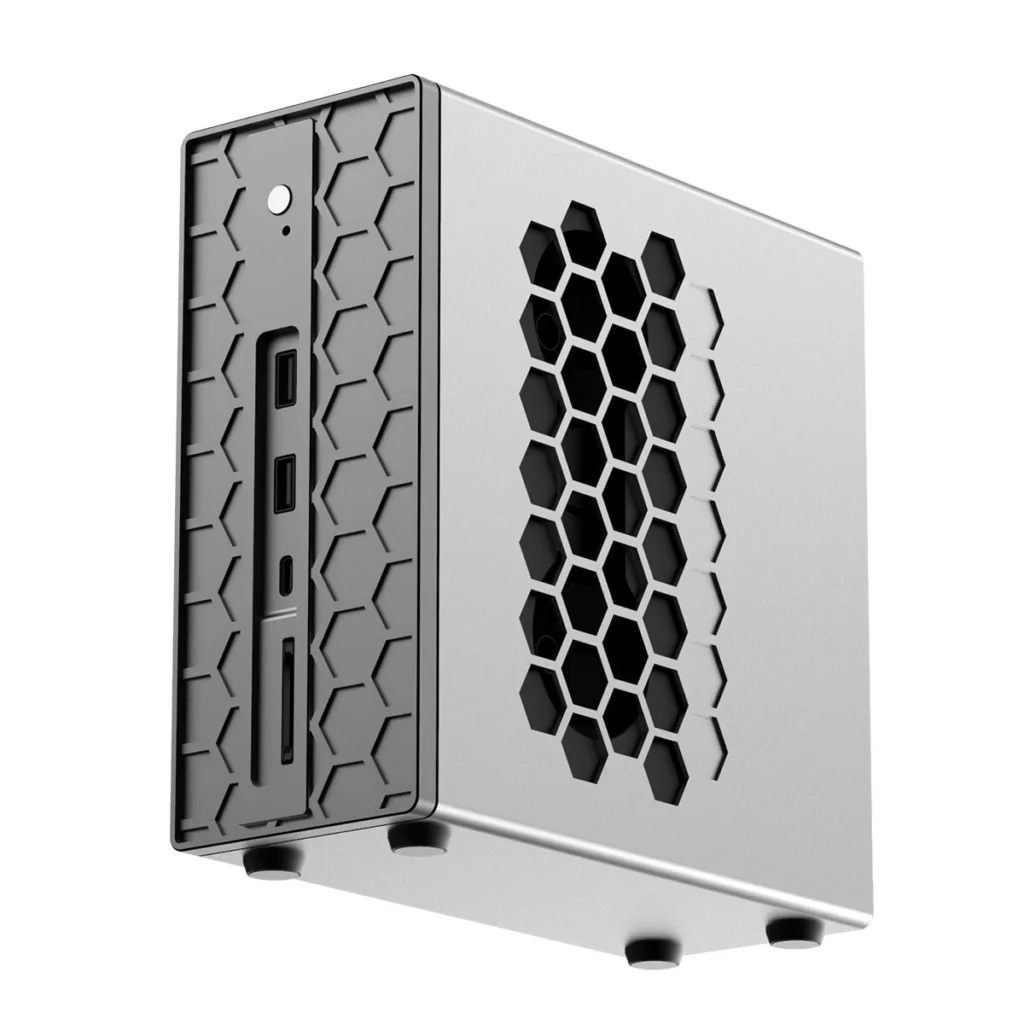
Despite its compact size of 220 × 220 × 83 mm and a volume slightly above 4 liters, TOPC has integrated a relatively robust cooling design. The chassis uses a silver-white finish with a hexagonal honeycomb design pattern, while internal cooling relies on two turbine-style fans and three heat pipes to maintain thermal stability under sustained load.
Connectivity is another strong point of the T03-395. The mini PC supports next-generation networking and high-bandwidth peripherals, making it suitable for professional environments where fast data transfer is essential.
Key specifications include:
- AMD Ryzen AI Max+ 395 processor
- 128GB LPDDR5X-8533 onboard memory
- 4× M.2 SSD slots (2× PCIe Gen4 x4, 2× PCIe Gen4 x2)
- Wi-Fi 7 support and Bluetooth 5.4
- Dual USB-C 40Gbps ports (front and rear)
- 2× USB-A 10Gbps + 4× USB-A 5Gbps ports
- HDMI 2.1 and DisplayPort 2.1 output
- 10GbE RJ45 + 2.5GbE RJ45 networking
- SD card reader and 3.5mm audio jack
- Dual turbine cooling fans with triple heat pipes
- Compact 4L-class chassis design
With its mix of high memory capacity, extensive storage expansion, and modern I/O, the TOPC T03-395 aims to bridge the gap between compact PCs and full desktop workstations. While pricing and global availability details remain limited, the hardware configuration suggests a strong focus on professional and high-performance computing workloads.