MelGeek has officially expanded its product lineup with the launch of the Horus, marking the company’s first entry into the mouse market. The Horus was introduced on January 9 and reflects MelGeek’s move beyond mechanical keyboards and desk accessories into performance-focused input devices.
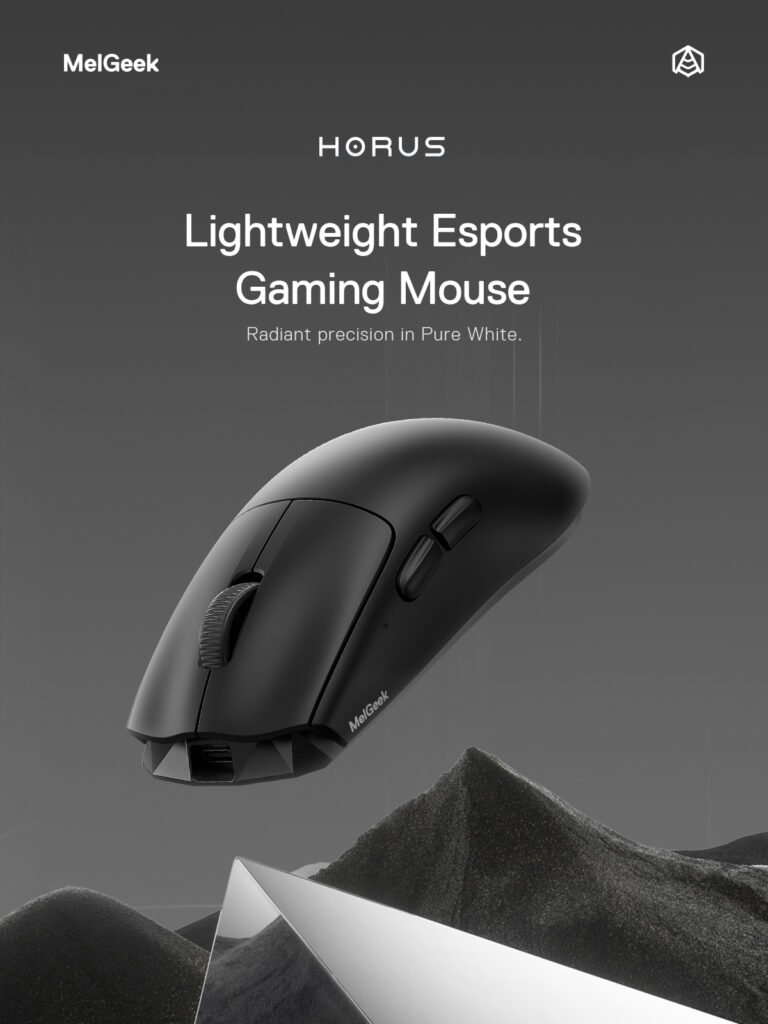
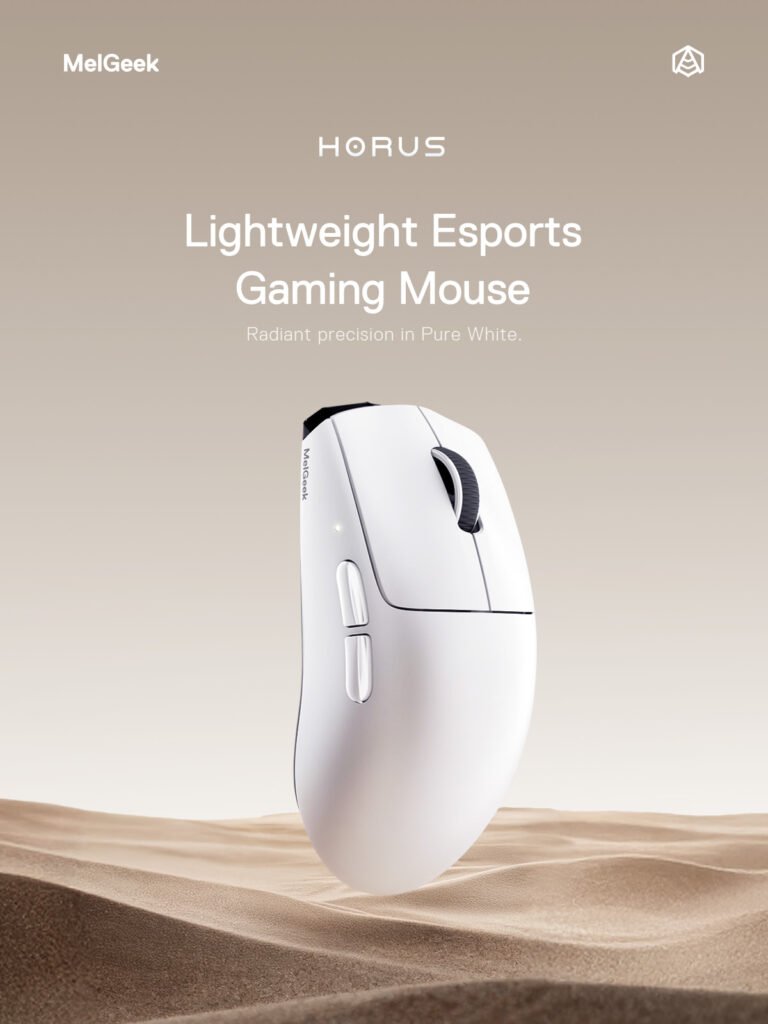
The Horus is built around a self-developed mold that uses a hollowed-out bottom structure to keep weight low. According to the company, the mouse weighs 49±2 grams, placing it among the lighter options currently available in the gaming mouse segment. At the core of the hardware is a Nordic nRF54L series main control chip, combined with a PixArt PAW3950 optical sensor. The sensor supports sensitivity levels of up to 30,000 CPI, aimed at users who prioritize precise tracking and quick input response.

From a design perspective, the Horus features a quasi-symmetrical shape that is intended to suit a wide range of grip styles. The back of the mouse is relatively flat while maintaining a full curve, and the waistline curves inward slightly to improve grip control. The left and right buttons include semi-enclosed grooves, offering defined finger placement without sharp edges. MelGeek states that the internal weight distribution is centered to maintain balance during fast movements. The exterior is finished with a mist-textured anti-slip coating, while the base uses PTFE feet to reduce friction on mousepads.
Switch options are also customizable. Buyers can choose between TTC or Omron optical microswitches, depending on their preference for click feel and response. Scrolling is handled by a TTC Blue Dragon roller encoder. In terms of connectivity, the Horus supports both wired and wireless operation. The wired USB-C mode and the 2.4GHz wireless mode each support an 8kHz polling rate. MelGeek lists a wired latency of 0.20ms and a wireless latency of 0.25ms.
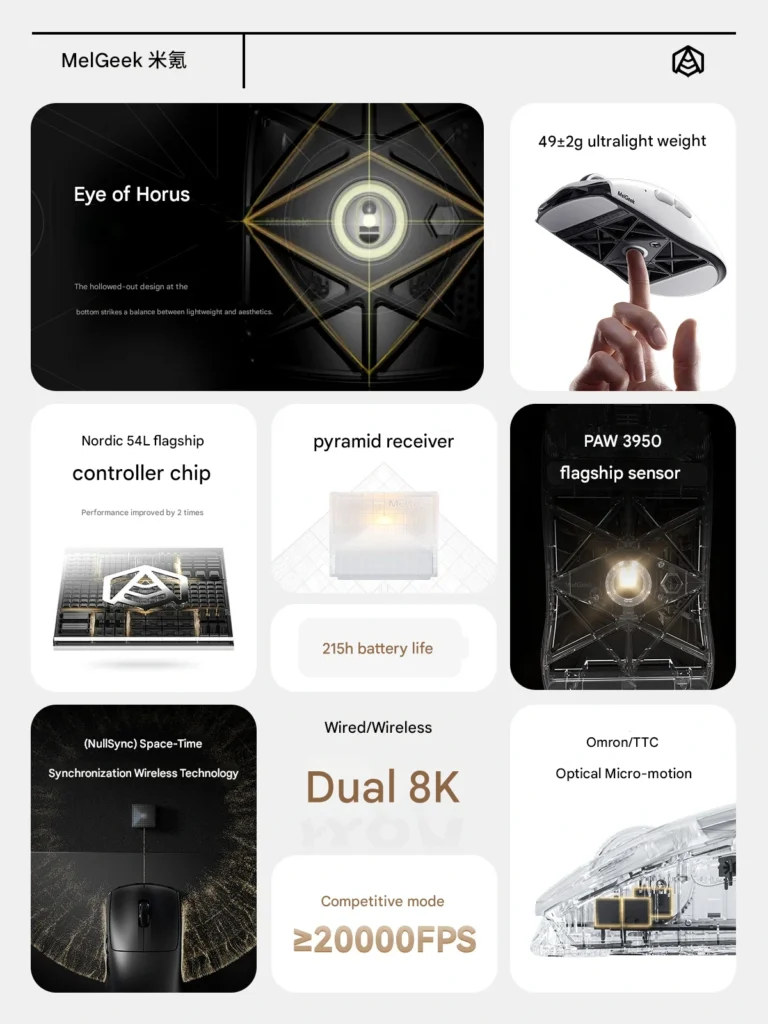
The mouse includes a built-in 300mAh battery. Under certain usage conditions, MelGeek claims the Horus can deliver up to 215 hours of battery life, though actual results may vary depending on polling rate and usage patterns.
With the release of the Horus, MelGeek enters a competitive market that includes several established peripheral brands. While pricing and regional availability have not yet been fully detailed, the Horus represents MelGeek’s initial step toward building a broader ecosystem of gaming-focused input devices.