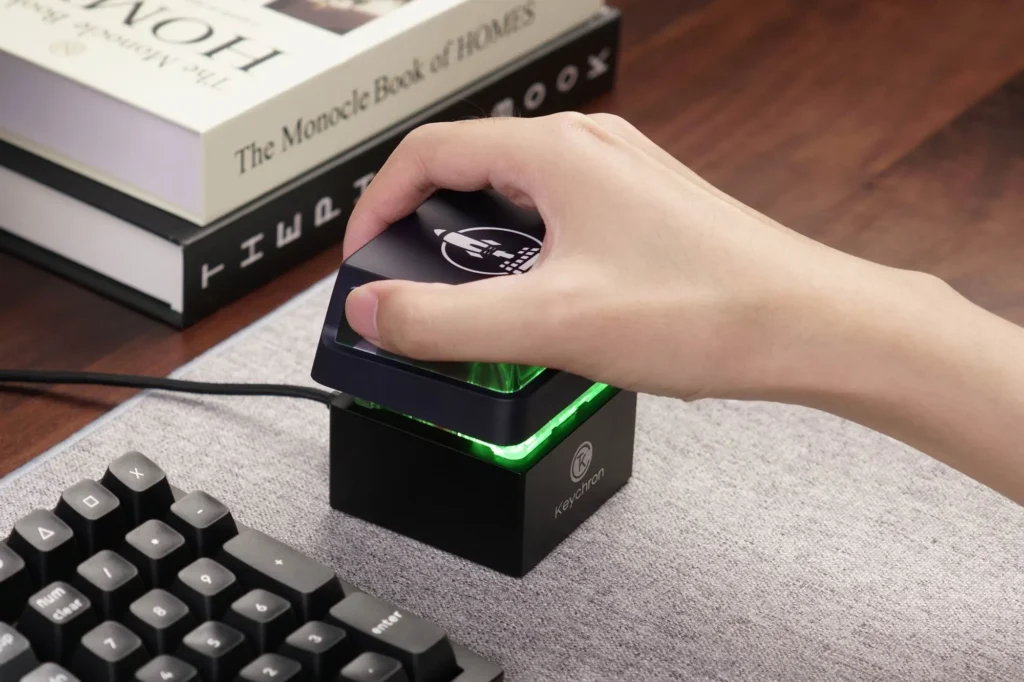
Keychron has expanded its mechanical keyboard portfolio with the introduction of the Q0 Mini 8K, a highly unconventional device that breaks away from the traditional multi-key layout. Instead of a full set of keys, the Q0 Mini 8K is built around a single oversized mechanical switch, designed for niche input applications and experimental control setups.
The Q0 Mini 8K features a uniquely scaled switch design. Keychron states that the switch is approximately four times larger in length, width, and height compared to a standard mechanical switch. This results in a total volume increase of nearly 64 times, giving the device a distinct physical presence compared to standard compact keyboards.
Despite its minimal input design, the keyboard is equipped with high-performance hardware. It supports an 8000Hz polling rate through wired connectivity, which significantly reduces input latency compared to standard gaming keyboards. This makes it suitable for scenarios where rapid signal transmission is required, even though the input itself is limited to a single switch.
The Q0 Mini 8K runs on QMK open-source firmware, allowing users to customize input behavior and remap functions as needed. Keychron also provides support through its web-based Launcher tool, which removes the need for traditional software installation and enables configuration directly from a browser.
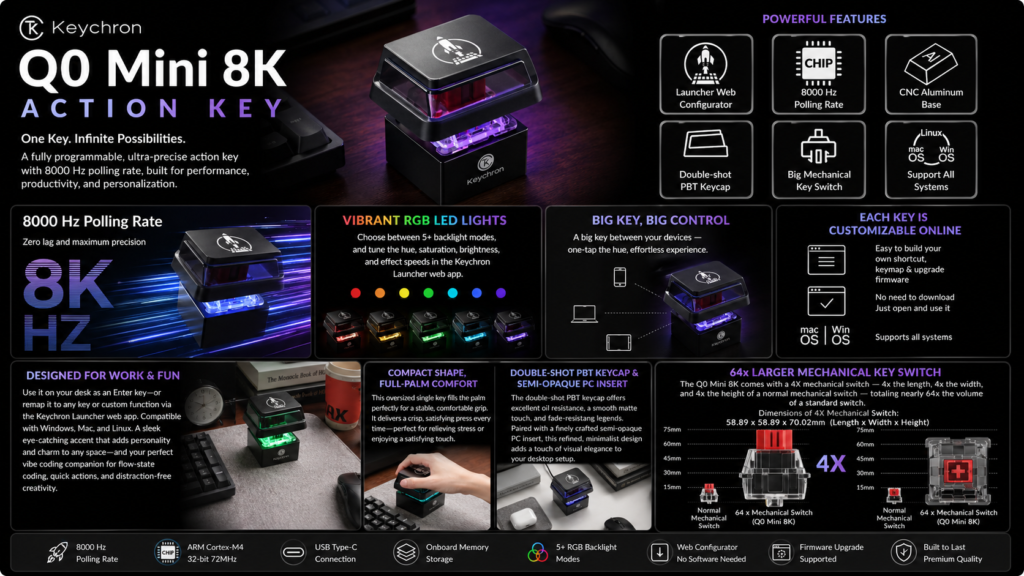
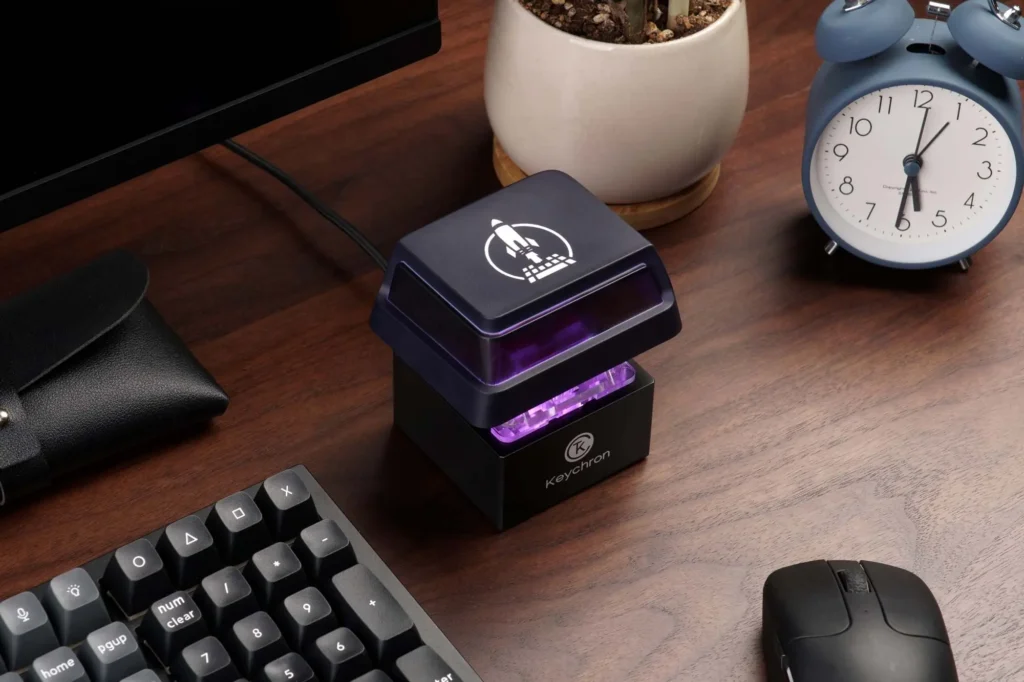
From a build perspective, the keyboard features a CNC-machined aluminum case that adds durability and rigidity. It also includes integrated RGB backlighting, giving visual feedback around the oversized switch. The keycap structure uses a double-shot PBT outer layer combined with a translucent PC inner shell, allowing lighting to diffuse evenly across the surface.
Priced at $64.99, the Q0 Mini 8K is not positioned as a conventional typing or gaming keyboard. Instead, it targets enthusiasts interested in custom input devices, macro control systems, or experimental hardware setups where a single programmable input is sufficient.
With this release, Keychron continues to explore unconventional keyboard designs while maintaining support for open-source firmware and enthusiast-grade materials, reinforcing its position in the mechanical keyboard market.