It has been a decade since NVIDIA introduced the GeForce GTX 10 series, marking a key moment in the evolution of desktop Graphics Cards. First released in May 2016, the lineup debuted with the GeForce GTX 1080, powered by the “Pascal” architecture and manufactured on TSMC’s 16 nm FinFET process. At the time, this transition delivered a noticeable jump in both efficiency and raw performance compared to the outgoing Maxwell generation.
The GTX 1080 quickly became a reference point for high-end gaming GPUs. It delivered enough power to run many AAA titles at 4K resolution using native rendering, without relying on upscaling technologies that are now common in modern pipelines. Despite its capabilities, the card maintained a relatively modest power requirement, using a single 150W 8-pin connector. This balance helped position Pascal as one of the more efficient architectures released by NVIDIA.
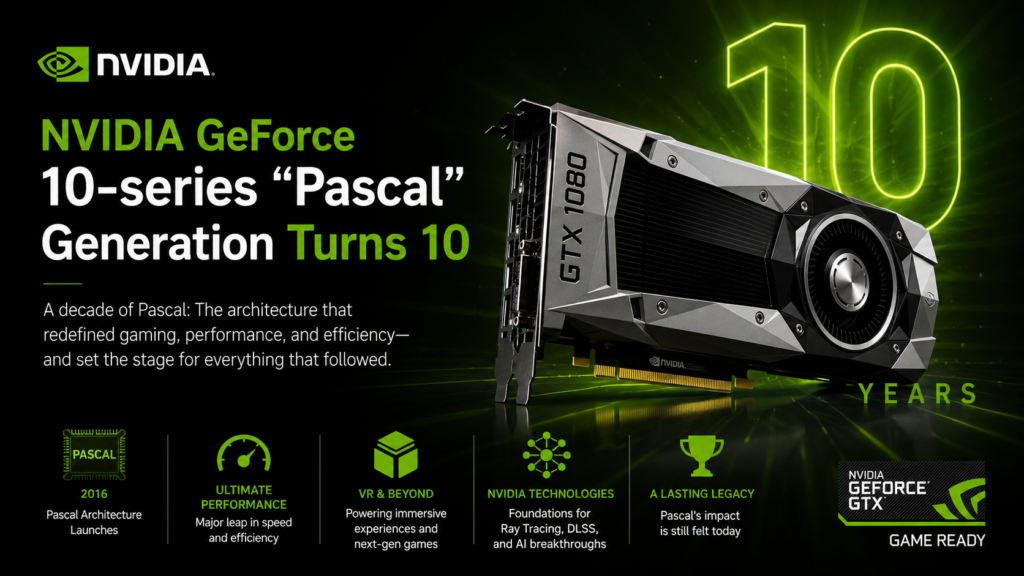
The GTX 10 series also brought notable gains in performance-per-watt. With higher clock speeds and refinements to the Pascal architecture, these GPUs achieved stronger results without a major increase in power consumption. This meant many systems could run quieter and produce less heat, while still delivering solid gaming performance across a wide range of titles.
The generation is also often associated with the tail end of consistent gains predicted by Moore’s Law. Each new release during that period brought visible improvements without major trade-offs. In contrast, more recent GPU generations have shifted toward higher power budgets and additional features such as hardware ray tracing and AI-assisted rendering.
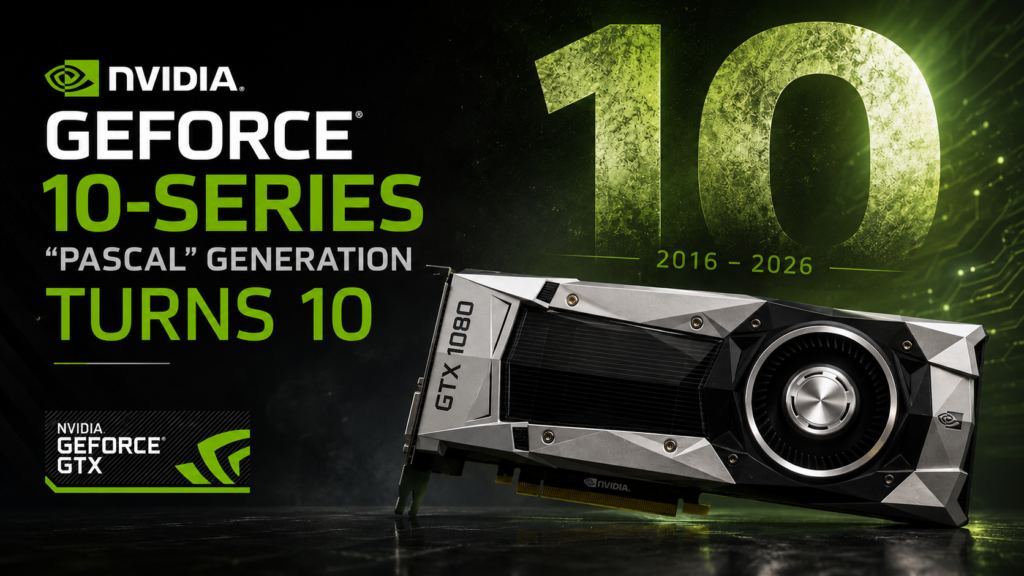
Beyond gaming, Pascal GPUs also found use in early compute and AI workloads, helping expand NVIDIA’s reach into data centers and research applications. While newer RTX graphics cards have introduced advanced features, the GTX 10 series continues to be remembered for its efficiency and dependable raster performance.
Ten years later, the Pascal era remains a notable chapter in GPU development. The GTX 1080, in particular, still represents a point where performance gains, power efficiency, and practical usability were closely aligned, leaving a lasting impact on both gamers and the broader PC hardware market.