Qualcomm is expected to maintain its revised flagship chipset strategy in 2026, according to a new industry rumor. After introducing a split launch with the Snapdragon 8 Elite Gen 5 series this year, the company may once again release two versions of its top-tier processor under the Snapdragon 8 Elite Gen 6 name. The approach is said to include a standard model and a higher-end version identified by a “Pro” label.
The information comes from Smart Chip Insider on Weibo, which claims that the Snapdragon 8 Elite Gen 6 Pro will sit at the top of Qualcomm’s mobile silicon lineup next year. However, the report suggests that widespread adoption of the Pro variant may be limited due to its expected pricing. The chipset is rumored to be Qualcomm’s first system-on-chip to enter mass production using TSMC’s 2nm manufacturing process, a move that is widely seen as costly for chip designers.
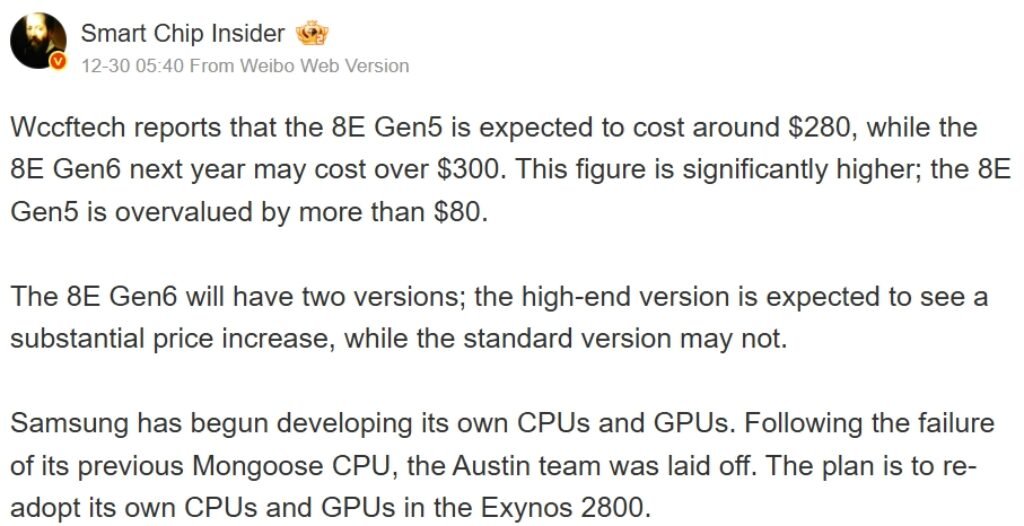
Estimates circulating within the semiconductor industry indicate that each 2nm wafer could cost around $30,000, significantly higher than current nodes. This alone is expected to raise the base cost of the Snapdragon 8 Elite Gen 6 Pro. For comparison, previous rumors suggested that the Snapdragon 8 Elite Gen 5 could cost smartphone makers up to $280 per unit, depending on order volume and agreements with Qualcomm. With a new Oryon CPU architecture and more advanced lithography, the Gen 6 Pro is expected to push past the $300 mark.
Such pricing could limit the Pro chipset to a small number of premium smartphones. The report claims that most manufacturers may reserve it for their highest-end models, often released in limited quantities or aimed at niche segments where higher component costs can be justified. This could include devices focused on peak performance, advanced gaming features, or brand positioning rather than mass-market appeal.
In contrast, the standard Snapdragon 8 Elite Gen 6 is rumored to avoid a major price increase. As a result, it may become the primary choice for flagship smartphones in 2026. According to the same source, this version will likely make up the majority of Qualcomm-powered high-end device shipments next year. However, the more accessible pricing is expected to come with trade-offs.
Early details suggest that the non-Pro Snapdragon 8 Elite Gen 6 may not support LPDDR6 memory and could ship with a less capable GPU compared to the Pro model. While these omissions could affect peak performance, they may also help manufacturers manage costs and power consumption. This balance could be appealing at a time when component prices remain under pressure.
Thermal and power considerations may also influence adoption. Reports around the Snapdragon 8 Elite Gen 5 indicated that high power draw was needed to compete with Apple’s latest chips. If similar behavior carries over to the Gen 6 Pro, manufacturers may struggle to fully utilize its performance without advanced cooling systems, further limiting its use.
The broader market context also plays a role. Ongoing memory supply challenges are expected to raise the smartphone bill of materials by as much as 25 percent. Some companies are reportedly reconsidering RAM configurations across their portfolios, including delaying wider adoption of 16GB memory in premium models.
Taken together, these factors suggest that while the Snapdragon 8 Elite Gen 6 Pro may represent Qualcomm’s peak mobile performance in 2026, the standard Snapdragon 8 Elite Gen 6 is likely to see wider use across flagship smartphones. More details are expected as Qualcomm’s launch timeline approaches.
Source: Wccftech, Smart Chip Insider