AMD has begun releasing its AGESA PI 1.2.8.0 BIOS update across a limited group of motherboards, with the primary aim of refining memory compatibility for current and upcoming platforms. While the update is positioned as a technical improvement, early reports from the community indicate that the rollout may not be smooth for all systems. Users who installed the update are reporting severe operational issues, pointing to possible instability in this early phase.
A detailed early account surfaced from a Chiphell forum member who upgraded their system to AGESA PI 1.2.8.0 with the expectation of improved tuning and overall efficiency. After applying the update, the system began exhibiting serious stability issues. Opening the CMOS screen triggered immediate crashes, eliminating the possibility of adjusting BIOS settings. The operating system refused to load, and attempts to run the boot repair tool repeatedly resulted in system crashes. These issues point to the possibility that the firmware may not behave consistently across all hardware revisions.
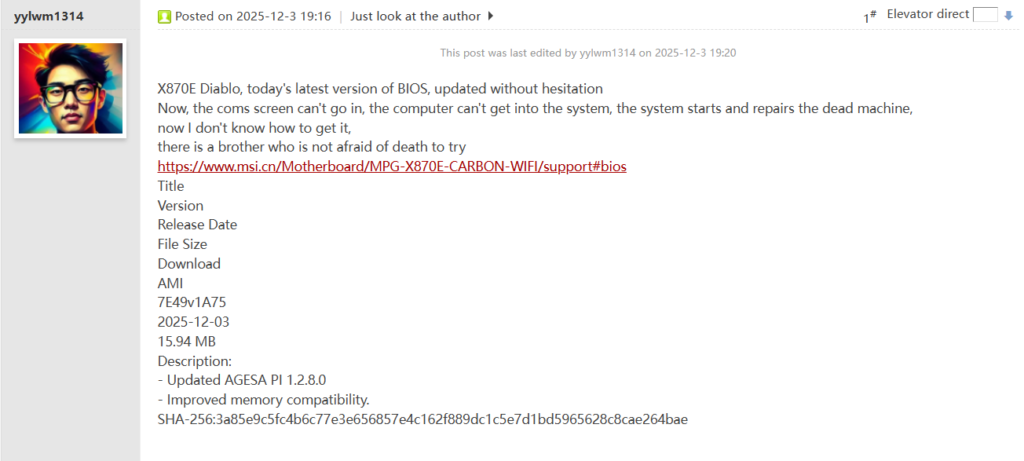
The distribution of the new BIOS appears limited and handled quietly by several manufacturers. MSI is among the few vendors publishing early builds, listing AGESA PI 1.2.8.0 on select models such as the MPG X870E Edge Ti WiFi, MPG X870E Carbon WiFi, and MAG B850M Mortar. An AMI BIOS file labelled 7E59v1A65, dated 2025-12-03, shows a file size of around 15.9 MB and notes improved memory compatibility in its changelog. Beyond this improvement, no additional changes are clearly detailed, leaving users to discover the practical effects through first-hand testing.
Earlier in the AGESA 1.2.7.x cycle, several vendors made rapid adjustments to their releases. ASUS withdrew its 1804 BIOS and replaced it with version 1805 following reports of irregular behaviour. ASRock appears to have skipped ahead by moving directly from AGESA 1.2.03 to 1.2.8.0 in beta form. AMD’s previous AGESA 1.2.7.0 release included references to Strix Point within its code structure, suggesting that 1.2.8.0 may continue laying the groundwork for new APUs. This could include refined memory behaviour for platforms linked to “Krackan Point” and potential desktop variants of Strix Point.
Given the issues emerging from early adopters, users currently running stable BIOS versions are advised to delay updating until further confirmation of stability is available. Firmware updates often receive multiple revisions as manufacturers gather feedback, and broader availability will likely follow once vendors address critical issues. As community reports continue to surface, a clearer understanding of AGESA PI 1.2.8.0’s reliability and its impact on next-generation hardware should develop in the coming weeks.
Source: Wccftech