As more artificial intelligence workloads move from cloud platforms to personal computers, hardware manufacturers are exploring new ways to handle the growing memory requirements of local AI models. Larger language models, extended context windows, and multi-agent applications can put considerable pressure on system RAM and GPU memory. ORICO is addressing part of this challenge with its upcoming FlashMem FM9800, an AI-focused SSD that combines conventional storage with dedicated cache space for local inference workloads.
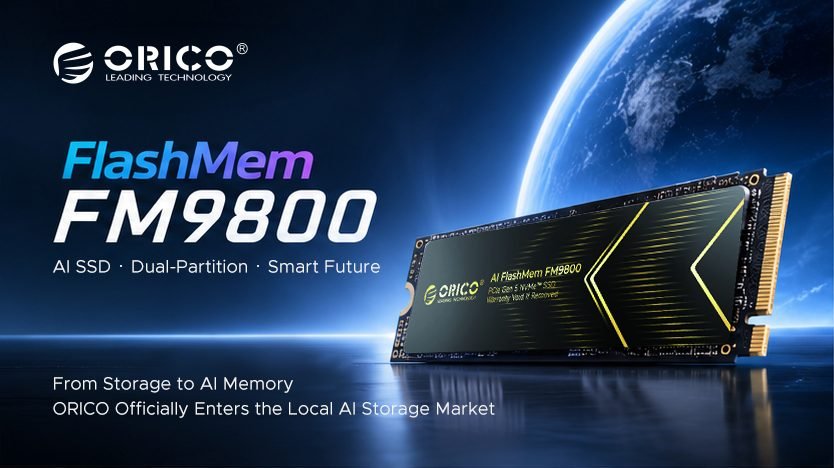
The ORICO FlashMem FM9800 uses a PCIe 5.0 interface and an M.2 2280 form factor. The company plans to offer the drive in 1TB and 2TB capacities, with its storage divided into two areas: Storage OS and AI Cache. The first is intended for the operating system, applications, and everyday files, while the second is designed to hold selected AI model weights, context data, and inference cache.
The drive is also designed to work with AI storage middleware and ORICO’s Herdsman local inference engine. Through firmware policies and host-side software, the system coordinates data between GPU memory, system RAM, and the dedicated AI cache. This approach adds another storage tier to compatible AI systems, allowing selected data to remain on the SSD rather than occupying high-speed memory at all times.

However, the FM9800 is not intended to replace system DRAM or GPU VRAM. NAND flash storage has different performance characteristics, and its usefulness for AI inference will depend on how effectively the software manages data movement between memory tiers. Instead, ORICO is targeting users who want to experiment with larger local AI models on systems with limited memory capacity.
Potential applications include local document processing, software development, research, and handling sensitive business information without relying entirely on cloud-based AI services. Compatibility will remain an important consideration, as the FM9800 requires supported hardware, operating systems, inference engines, and AI model versions.

With the FlashMem FM9800, ORICO is extending its storage portfolio into the emerging local AI hardware market. The company continues to develop conventional storage products, including portable SSDs, USB flash drives, and memory cards, while its USB4 and Thunderbolt 5 products target high-performance storage workflows.

The FM9800’s market reception will likely depend on software compatibility, sustained performance, and measurable improvements in supported AI applications. Pricing, sequential read and write speeds, and availability have not yet been specified in the supplied announcement. Nevertheless, ORICO’s new SSD reflects a growing interest in using storage as another component of the local AI data-management pipeline rather than simply a place to keep files and applications.
ORICO FlashMem FM9800 AI SSD Specifications
| Specification | ORICO FlashMem FM9800 |
|---|---|
| Product Name | FlashMem FM9800 |
| Product Type | AI SSD |
| Interface | PCIe 5.0 |
| Form Factor | M.2 2280 |
| NAND Flash | 3D TLC NAND |
| AI Cache Technology | pSLC |
| Capacity Options | 1TB / 2TB |
| 1TB AI Cache | 85GB |
| 1TB Storage OS | 768GB |
| 2TB AI Cache | 128GB |
| 2TB Storage OS | 1,638GB |
| Storage Architecture | Dual-partition design |
| AI Cache Usage | Model weights, context data, inference data |
| Software Support | AI Storage Middleware |
| Inference Engine | Herdsman |
| Memory Coordination | GPU VRAM, System RAM, AI Cache |
| Cache Management | Independent wear-management and read/write scheduling |
| Cooling | Graphene thermal pad |
| Operating System | Supported OS versions (not specified) |
| Sequential Read Speed | Not announced |
| Sequential Write Speed | Not announced |
| Endurance (TBW) | Not announced |
| Warranty | Not announced |
| Pricing | Not announced |
| Availability | Not announced |