Capcom has announced that Monster Hunter Wilds Title Update 4 will be released on December 16, 2025, bringing new content and a wide range of stability and performance improvements. The update will be available across PlayStation 5, Xbox Series X|S, and PC via Steam.
The update introduces Gogmazios, making its debut as the first Elder Dragon to appear in Monster Hunter Wilds. Alongside the new monster, Capcom is expanding endgame content through the addition of Gogma Artian Weapons, giving players new equipment options after completing late-game hunts.
Platform-Wide Performance Improvements
Title Update 4 places a strong emphasis on improving performance and stability. Capcom confirmed that CPU and GPU optimizations are being applied across all platforms. These changes focus on reducing heavy processing loads while keeping existing gameplay systems intact.
The update introduces a method that distributes high-load processes across multiple frames. Core gameplay elements such as player characters, monsters, and interface components, including the HUD and in-game maps, are handled over a longer processing window. This approach is intended to smooth system workload and reduce sudden performance spikes.
The development team has also reviewed and adjusted several internal systems. These changes include reducing the number of simultaneous visual effects, improving collision detection for Palico and Seikret companions, and streamlining various background processes. Memory usage has also been optimized, with additional improvements planned to further reduce overhead during extended play sessions.
According to Capcom, these changes are intended to improve the experience for players across a wide range of hardware configurations, without introducing changes that could negatively affect gameplay balance or behavior.
PC Performance Testing on Recommended Hardware
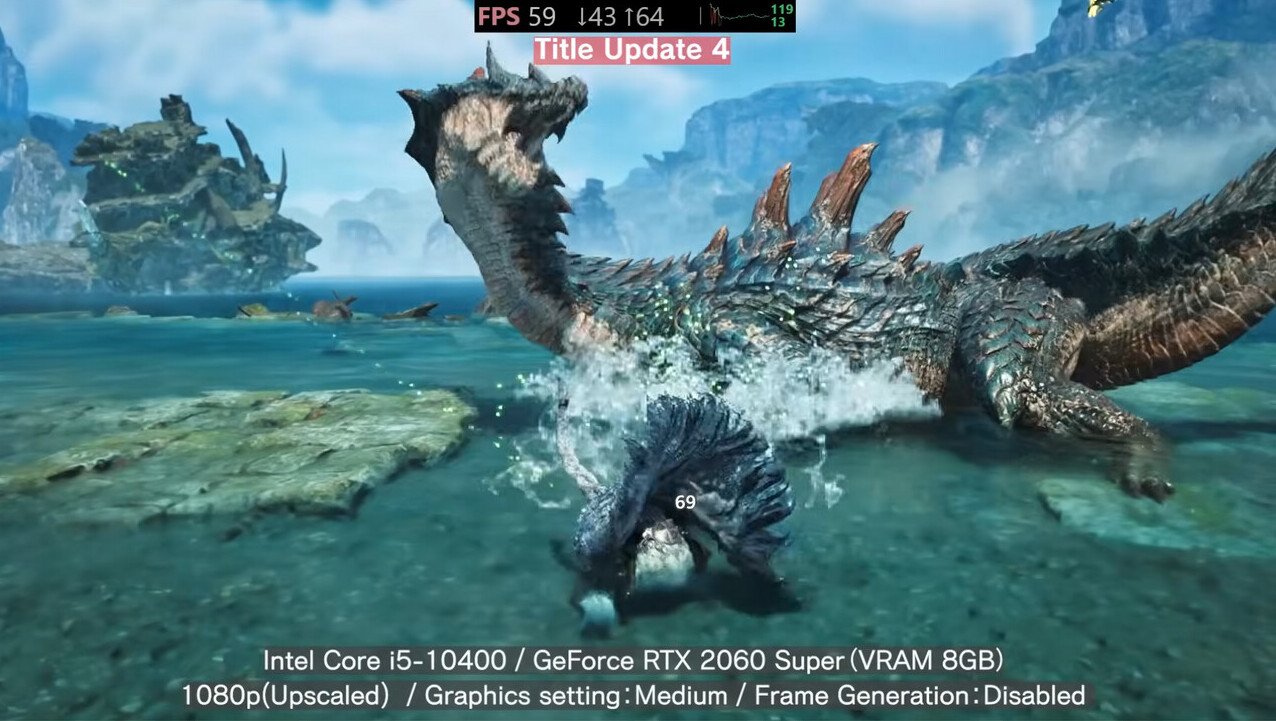
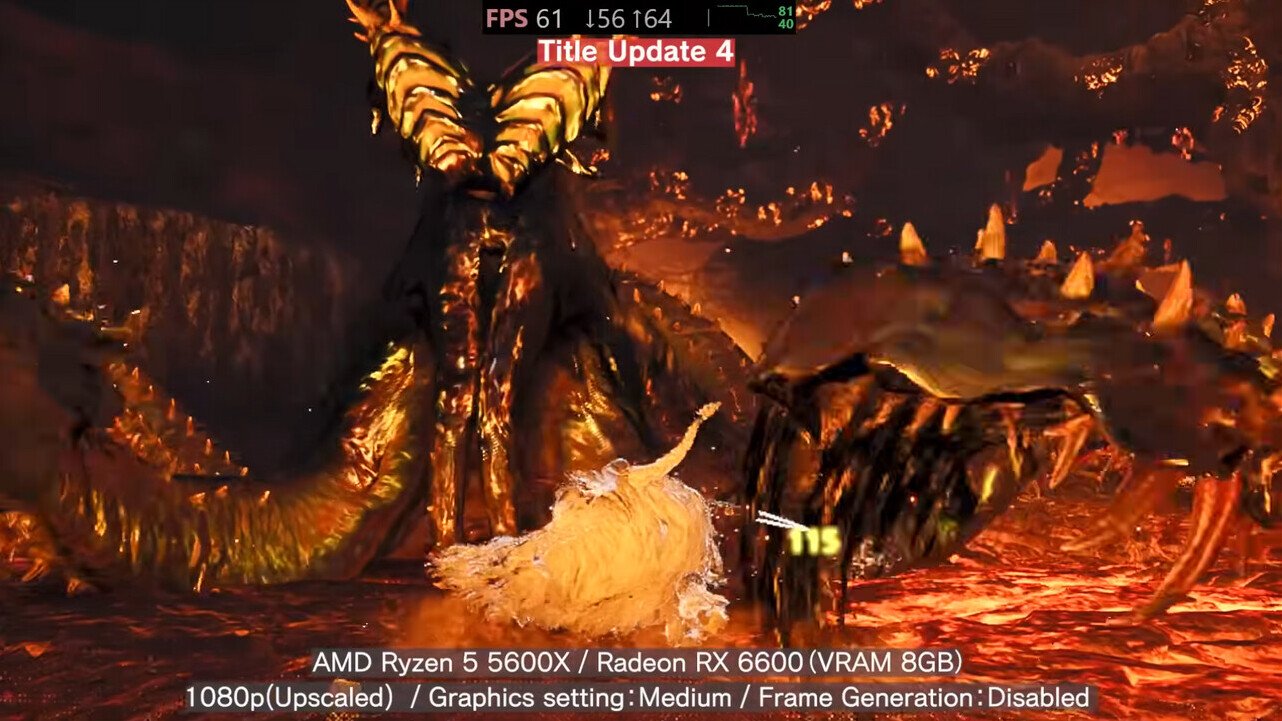
Capcom shared internal testing results comparing performance between Title Update 3 and Title Update 4 on the Steam version, using systems that meet the recommended specifications. All testing was conducted with frame generation disabled, and performance data was recorded using Steam’s in-game performance overlay.
Two hardware configurations were tested.
The first setup used an Intel Core i5-10400 paired with an NVIDIA GeForce RTX 2060 Super (8 GB VRAM). The game was run at 1080p with upscaling enabled using NVIDIA DLSS in Performance mode, and graphics settings set to Medium.
The second setup used an AMD Ryzen 5 5600X and an AMD Radeon RX 6600 (8 GB VRAM). This configuration also ran at 1080p with upscaling enabled through AMD FSR in Performance mode, using Medium graphics settings.
In areas such as Windward Plains, which is known for higher system load during inclement events, frame rates previously remained around 40 FPS with frame generation disabled. After applying Title Update 4, Capcom confirmed that frame rates exceeded 40 FPS in most cases. Additional testing showed an average improvement of around 5 percent or more in other locations, including Scarlet Forest and Oilwell Basin.
Capcom noted that these results are based on internal testing and that performance may vary depending on individual system configurations. The company also stated that systems meeting minimum requirements may see smaller gains compared to systems closer to the recommended specifications.
Monster Hunter Wilds Benchmark to Be Removed on Steam
Following the release of Title Update 4, Capcom plans to remove the Monster Hunter Wilds Benchmark from Steam. The company explained that performance improvements in the retail version have made the benchmark results outdated, as they no longer reflect the current state of the game.
Steam-Exclusive Patch Planned for January 2026
Additional improvements for the PC version are scheduled for late January 2026 through a Steam-exclusive patch. This update will focus on Steam-specific optimizations and additional options designed to reduce system load.
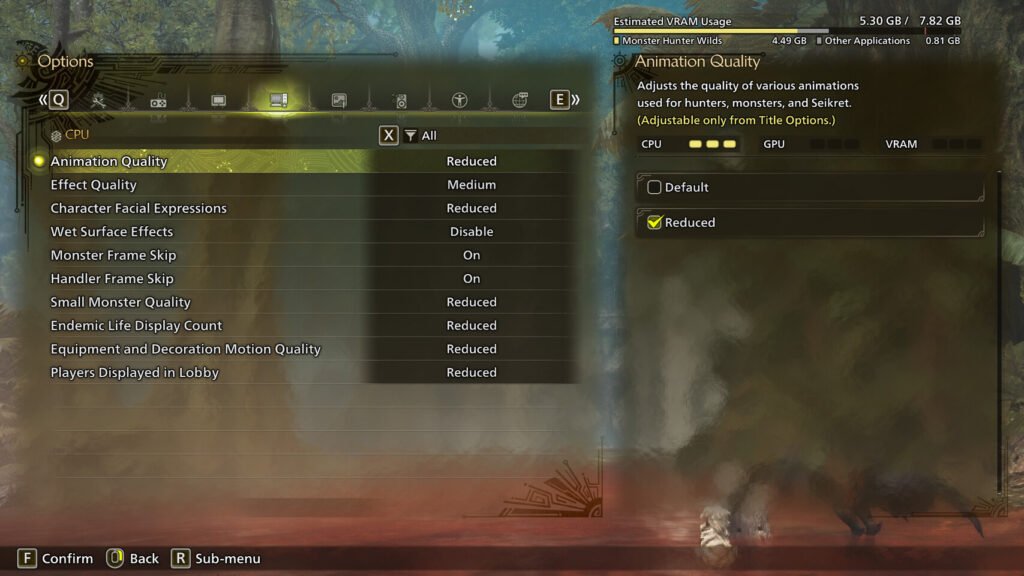
A new CPU tab will be added to the Options menu, allowing players to adjust settings such as Endemic Life display count, the number of players shown in lobbies, small monster quality, effect quality, and animation quality. These options are intended to give players more control over CPU usage.
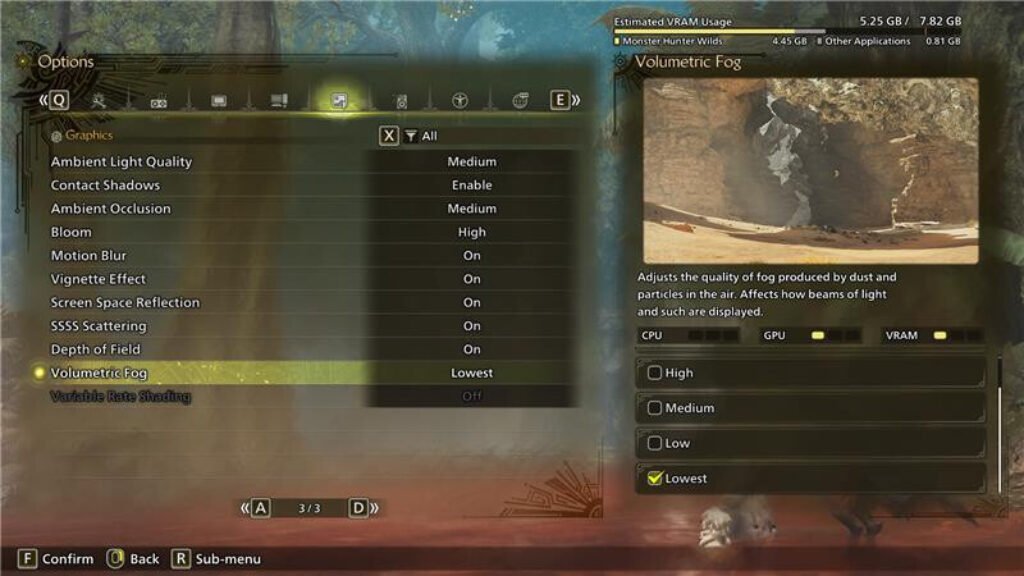
On the GPU side, new graphics options such as Foliage Density will be introduced, along with expanded control over existing settings like volumetric fog. Capcom also plans further improvements to VRAM usage, better handling of the high-resolution texture pack, faster texture streaming, and reduced shader compilation wait times when launching the game.
Version 1.041 Update Coming in February 2026
Capcom also confirmed that Version 1.041 will be released in February 2026. This update will add Arch-Tempered Arkveld and additional content, while continuing the optimization work.
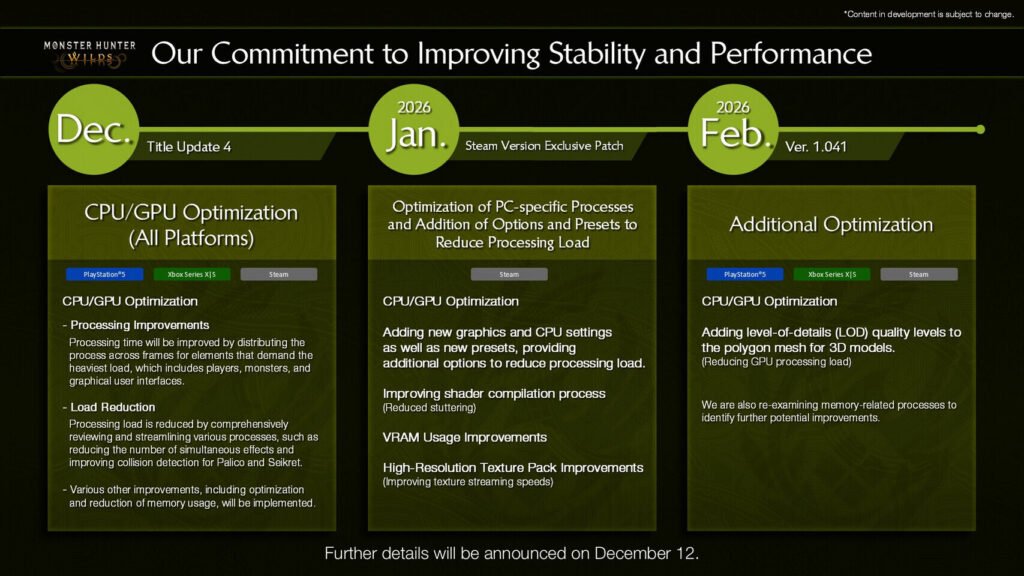
Planned improvements include further CPU and GPU adjustments, as well as the introduction of quality levels for polygon meshes on 3D models. This system is intended to reduce processing load by switching to lower-detail models for objects farther from the camera. Memory-related processes are also being reviewed for further refinements.
Ongoing Support and Player Feedback
Capcom acknowledged that internal testing cannot account for the full range of player hardware and software environments. The company stated that player reports and feedback have played an important role in identifying issues and guiding improvements.
Players on PC are advised to review system requirements and graphics driver compatibility ahead of Title Update 4, as certain driver versions or background software may still cause issues.
With new content arriving alongside performance-focused updates, Title Update 4 represents a major step in Monster Hunter Wilds’ post-launch roadmap, with further improvements already planned into early 2026.