Everstone Studio’s open-world action RPG Where Winds Meet has crossed 9 million downloads across PC and PS5, and its recent mobile launch has opened a new chapter for the title. With the game now available on both the App Store and Google Play Store, players have begun comparing how the iOS and Android versions perform on the latest flagship smartphones. Early tests are already highlighting noticeable differences in rendering quality, frame stability, and overall gameplay smoothness.
A detailed comparison from Dame Tech provides an early look at how the game handles on the iPhone 17 Pro Max, powered by Apple’s A19 Pro chipset, versus the REDMAGIC 11 Pro equipped with Qualcomm’s Snapdragon 8 Elite Gen 5. Both devices support a range of graphics settings that allow players to adjust visuals according to their preference, including resolution scaling, shadows, and other effects. Despite this flexibility, the testing shows that the two chipsets deliver different levels of stability during extended gameplay.
The iPhone 17 Pro Max stands out for its consistent frame pacing throughout the comparison. The A19 Pro maintains 60 FPS across various scenes, including combat encounters and open-world traversal, without visible frame interruptions. Even during moments with heavy visual effects or dense environmental detail, the iPhone sustains a smooth experience. In addition to frame-rate consistency, the device also renders the game at a higher resolution, resulting in cleaner textures and more detailed visuals during fast movements and close-up interactions.
Gameplay footage further shows that the iPhone’s thermal management helps maintain long-term stability. The device avoids any visible dips in performance, suggesting efficient handling of the game’s workload across both CPU and GPU tasks. These early results indicate that the A19 Pro is well-suited for a demanding title like Where Winds Meet, allowing players to enjoy a visually rich and responsive experience.
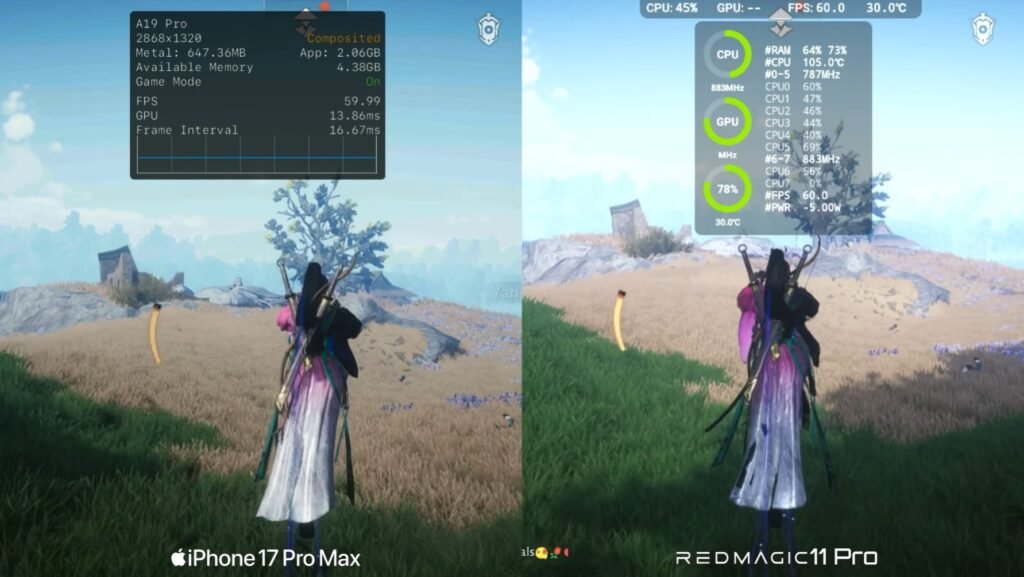
On the Android side, the Snapdragon 8 Elite Gen 5 demonstrates strong performance capabilities but shows weakness in one key area: “1% lows.” While the REDMAGIC 11 Pro reaches and often sustains 60 FPS, the dips that occur during graphically intense scenes are more noticeable than on the iPhone 17 Pro Max. The comparison video highlights moments where the Android device’s frame rate briefly drops, creating short interruptions during moments of fast action or when loading environmental elements.
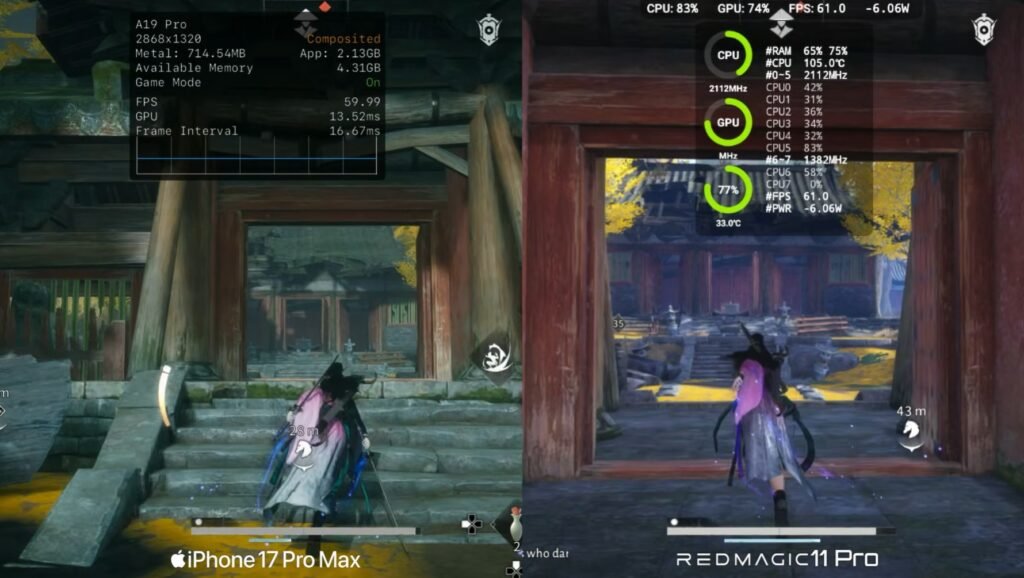
Interestingly, the REDMAGIC 11 Pro features both liquid cooling and an internal fan, and temperature readings during the test suggest that the chipset is not overheating. This indicates that thermal throttling is not the cause of the dips. Instead, it appears that software optimization may still be in progress for the Android version of the game. Since this is an early release, it is likely that future patches will refine performance and reduce the frequency of these drops.
Visual quality on the REDMAGIC 11 Pro remains high, but the iPhone’s ability to render the game at a higher resolution gives it an advantage in clarity. Textures on buildings, landscapes, and character clothing appear sharper on Apple’s flagship, adding more depth to the overall presentation.


As Where Winds Meet continues expanding into the mobile market, these early comparisons provide valuable insight into how the game performs across different hardware ecosystems. The iPhone 17 Pro Max currently offers a smoother and more stable experience, while the Snapdragon 8 Elite Gen 5 shows promise that may be further realized through upcoming updates. With the game’s download numbers growing and its mobile presence strengthening, players can expect ongoing improvements that enhance performance on both platforms.
These findings set the stage for continued interest in how future chipset updates and game patches will influence cross-platform performance, especially as more users begin exploring the world of Where Winds Meet on their smartphones.