RGB Mini-LED technology, which has primarily been discussed in the context of high-end televisions, may soon make its way to computer monitors. Unlike traditional Mini-LED setups that rely on white or blue backlights combined with quantum dot conversion, RGB Mini-LED panels generate red, green, and blue light individually. This approach allows for more accurate color reproduction and improved contrast on screen.
In the television market, Samsung and Hisense have been the most prominent developers of RGB Mini-LED technology. Their early models are unusually large, exceeding 100 inches, and focus on demonstrating the capabilities of the new backlighting system. Analysts anticipate that over time, RGB Mini-LED configurations will become available in more standard television sizes, ranging from 55 to 85 inches, making the technology more accessible to mainstream consumers.
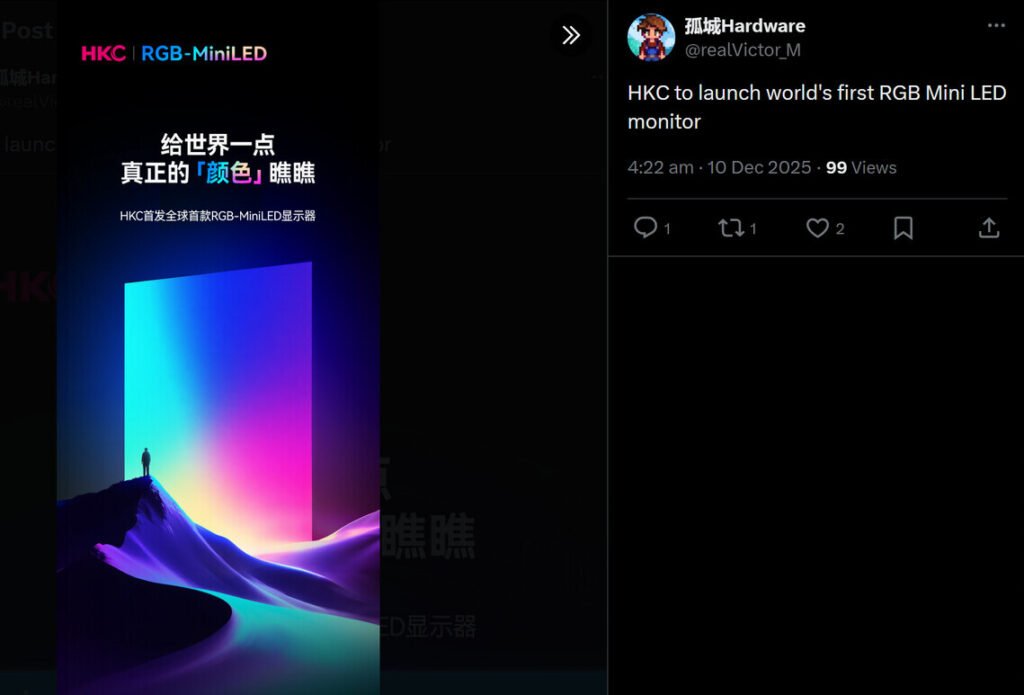
The next potential step for RGB Mini-LED is the monitor market, where HKC appears to be positioning itself as an early adopter. Leaked promotional material recently surfaced on social media via Lonely City Hardware (@realVictor_M), hinting that HKC may unveil a monitor featuring RGB Mini-LED technology at the CES trade event next month. If confirmed, this would represent the first commercially showcased RGB Mini-LED monitor, marking a notable shift in display technology for PC users.
Currently, HKC panels are utilized in products under KOORUI and ANTGAMING brands. These monitors often rely on conventional Mini-LED backlighting, which is already regarded as a strong alternative to OLED in gaming and professional applications. Mini-LED monitors offer high peak brightness, localized dimming zones, and better energy efficiency compared to older LCD designs. RGB Mini-LED could further enhance these advantages by providing more precise color representation and wider gamut coverage.
Despite these developments, OLED remains the most widely recognized high-end display option, particularly for gaming and creative work. It continues to dominate retail channels due to its established market presence and availability. Nevertheless, RGB Mini-LED monitors have the potential to bridge the gap between conventional LCD and OLED technology, offering a balance of brightness, color accuracy, and durability.
The expected launch of an RGB Mini-LED monitor by HKC at CES could signal the beginning of broader adoption of the technology in the monitor market. For gamers and content creators, it may provide new options for high-performance displays without requiring a shift to OLED, while maintaining many of the advantages that have made Mini-LED popular in premium TVs.
Sources: realVictor_M Tweet, Wccftech, VideoCardz, Flat Panels HD (historical)